
Asexuality and the ace spectrum in the LGBTQ+ community
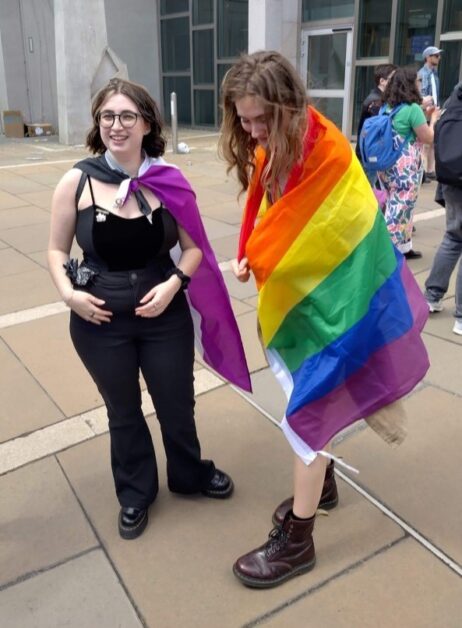
Asexuality is part of the ‘+’ in LGBTQ+, or the A in LGBTQIA+. For some, the ‘+’ feels inclusive, while for others, it can feel like an afterthought. In April 2020, LGBT Health and Wellbeing hosted a community discussion On The Plus Side, which explored whether people felt represented by the ‘+’ in our community acronym. You can read the report here.
Many of these identities remain underrepresented in the media, and I feel it’s especially important to uplift those that are often sidelined, such as asexuality. As a lesbian/sapphic individual, I have witnessed firsthand how important visibility and representation can be.
I’m fortunate to know someone who identifies as a-spec (an umbrella term for those on the asexual and/or aromantic spectrum). Their openness about their experiences has been invaluable in educating me, and now, I want to share Monica’s story to help others better understand the complexities of asexuality and the ace/aro spectrums. Please note that the terms mentioned here are not exhaustive, as many other labels and micro-labels exist within the community.
“I really tried to be open and honest about it all. Maybe hopefully I can help someone else going through similar experiences feel a little less alone.” — Monica
Monica’s words resonated deeply with me. They reflect the loneliness many a-spec individuals experience. In a society, especially in the West, where sex is often seen as a fundamental part of life—like food or water—coming to terms with asexuality can feel like one of the most “queer” identities to claim. This perception leads to unique struggles. For example, some people, even within the queer community, question whether asexuality is a valid sexual orientation.
What is asexuality?
Asexuality is a spectrum and a sexual orientation. Often abbreviated as ‘ace,’ it is commonly misunderstood. The asexual and aromantic communities are distinct but related; asexuality refers to a sexual orientation, while aromanticism pertains to romantic attraction. These identities are not mutually exclusive. For instance, someone can identify as asexual but not aromantic, or vice versa. Furthermore, asexual people may still experience romantic attraction, forming relationships that can be heteroromantic, homoromantic, biromantic, or panromantic.
Some individuals don’t fit neatly into the traditional definitions of asexuality but still identify with it. For example, people might use the term greysexual to describe those who experience sexual attraction rarely or under specific conditions. Demisexual, a term within the greysexual spectrum, refers to people who experience sexual attraction only after forming a deep emotional bond.
Monica’s story
I met Monica while working toward our master’s degrees at Edinburgh University. We both worked part-time at Van Gogh Alive, a role that required us to stand around and repeat ourselves to strangers. Our shared passion for queer issues quickly formed a bond, and we even attended Pride Edinburgh together.
At that time, Monica was one of the only openly asexual people I knew. I was eager to learn more, and Monica was open about their experiences as both an a-spec and non-binary person, using she/they pronouns. Monica initially identified as biromantic asexual but later expanded this identity to include greysexual and demisexual.
Coming out as asexual
Monica began exploring their asexual identity during their final year of high school. While they suspect they may have known earlier, the lack of language and representation made it difficult to understand. Monica’s journey toward self-acceptance was marked by a romantic relationship with a non-a-spec person. Their partner wanted more sexual intimacy than Monica felt comfortable with, and Monica realized they didn’t experience the physical attraction typically expected in a relationship.
“Them wanting to do more and more sexual acts made me feel more and more broken. I’d try to mentally convince myself I’d want to do something with them.” — Monica
The sense of brokenness Monica described is a common experience for many a-spec people. Monica explains, “There wasn’t this physical attraction everyone said I’d feel, or even grow to feel.”
After a difficult breakup, Monica turned to representation in books and media for comfort. They came out to a few close friends in high school and made an official announcement on Instagram during their first year of university. However, coming out to their mother was a traumatic experience:
“It was honestly so personally traumatic for me, that I’d never attempted it again. I don’t think she remembers the conversation, but I do…” — Monica
Monica’s mother, from a conservative background, didn’t understand asexuality. Her first question was, “Are you sure you haven’t found the right man yet?” This question deeply affected Monica, highlighting the societal expectations placed on asexual individuals.
The difficulty of coming out as asexual
Monica emphasizes that coming out as asexual is markedly different from coming out with other parts of their queer identity: “Coming out with my a-spec identities is truly a different experience from any of the other LGBTQIA+ labels I also use.” Even within the queer community, many people do not understand that the A in LGBTQIA+ stands for asexual, aromantic, and/or agender, not allies. This misunderstanding often makes it harder for people to come out as asexual, even to fellow LGBTQIA+ individuals.
Asexual representation in the media
Monica highlights the importance of media representation in their own journey of self-discovery. One significant influence was The Foxhole Court by Nora Sakavic. While the book doesn’t explicitly label the character Neil as demisexual, Monica found it to be a powerful tool for self-reflection: “It was enough for me to ignite the flame.” Monica also recommends Radio Silence and Loveless by Alice Oseman, and The Romantic Agenda by Claire Kann. These works, featuring asexual characters, made Monica feel seen and understood.
How can we be better allies to asexual people?
Monica’s main advice to allies is simple: “Mainly, just believe us.” Asexual individuals don’t need to have experienced trauma or sexual encounters to know their identity—this is true for all sexual identities. Monica also stresses the importance of not confusing asexuality with abstinence. Asexuality is an identity, while abstinence is a choice. To further educate yourself, Monica recommends checking out asexuality.org for valuable resources.
Finally, Monica wants to clarify that the A in LGBTQIA+ does not stand for ally. This misunderstanding, often well-meaning, can be damaging. Allies should actively correct this misconception, ensuring they support the true meaning of the acronym.